iOS App

Your terminals and coding agents, in your pocket. The Spaces iOS app is a full client, not a remote for the Mac app: it pairs directly with any Mac or Linux device running Spaces and talks to it on its own.

Check on your coding agents from anywhere

  • • Browse the live terminal sessions running across all your workspaces, with the coding agents that are working or waiting on you called out at a glance.
  • • Catch an agent that's blocked on you and clear it, or watch a build finish, without walking back to your desk.
  • • Create a workspace in any existing project, and open or stop its terminals.
  • • Run, stop, or restart configured processes and coding agents.
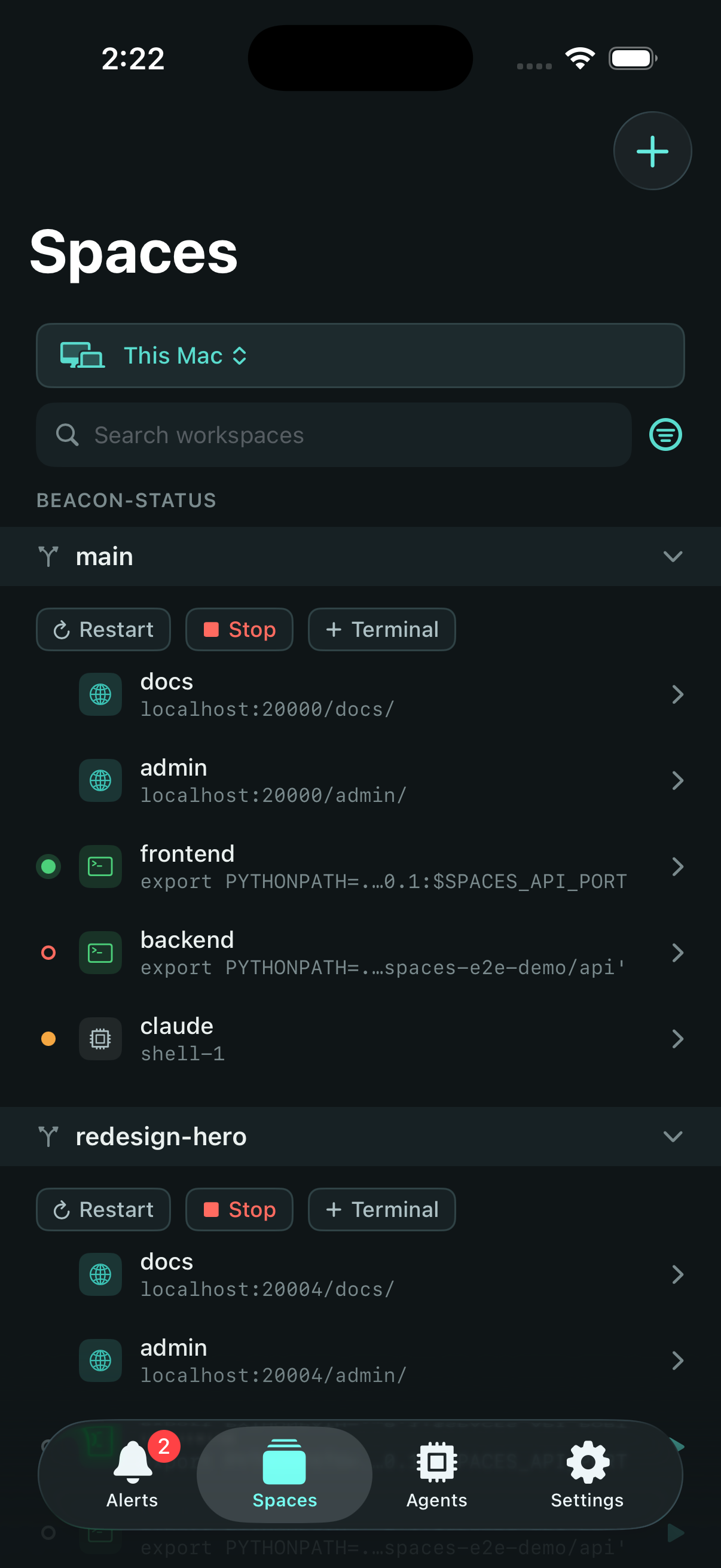
The Spaces iOS app showing a workspace's live terminal sessions and coding agents with their status

Jump into any session

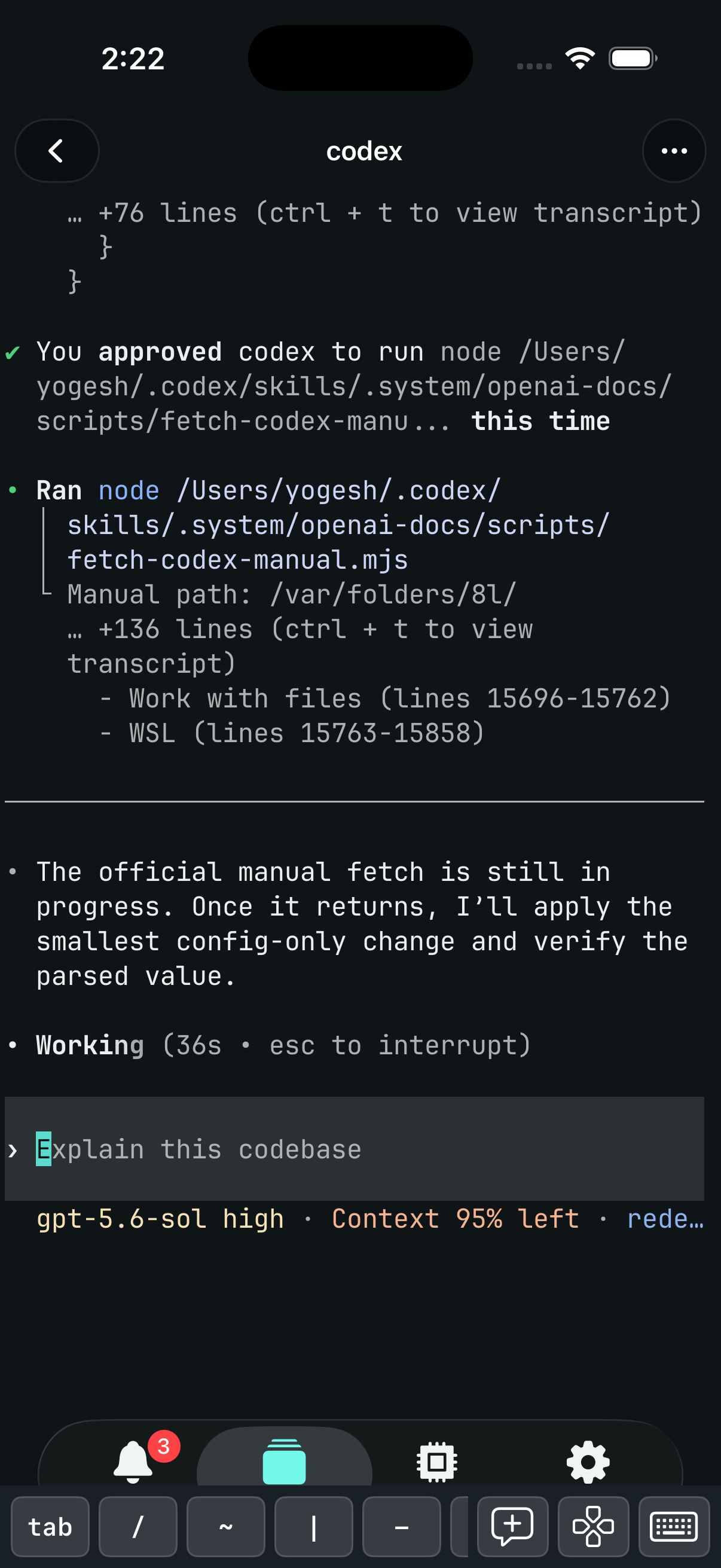
  • • Open a session to watch its output stream in and type into the same shell — answer an agent's prompt, run a command, or nudge a stuck task.
  • • Compose a longer, multi-line message and attach a screenshot or image, then send it to the session in one go.
  • • Everything you send goes to the one live session on the device that owns it, so every client watching — your phone, your Mac — stays in sync.
A live terminal session open in the Spaces iOS app, showing output and an input field

Open browser sessions on your phone

  • • A workspace's browser sessions show up as rows in the app. Tap one to load the dev server right inside an in-app web view — no need to unlock your Mac or remember a URL.
  • • Each web view has back, forward, reload, and screenshot controls, and stays isolated per service just like Chrome on the Mac.
  • • This works for a remote Linux workspace too, and even while the Mac is asleep. See Browser Sessions for details.

The Mac app is never in the middle

  • • The iOS app works by communicating directly to a connected device - any mac or linux machine running a Spaces daemon.
  • • Your sessions run in the Spaces daemon, not the desktop app, so they keep running even if the Mac app quit or crashed.

Try Spaces without a Mac

  • • Not set up yet? Turn on Demo Mode from Settings, or tap Try Demo Mode on the Spaces tab, to tour the whole app with sample data — workspaces, coding agents, alerts, and terminals — before you pair a single device.
  • • Demo terminals are read-only: you can watch and scroll a session, and typing into a terminal starts once you pair your own Mac. A banner keeps the sample-data context clear, and one tap turns it off.

Pairing

Coming soon
  • • On your Mac, open Settings → Devices. Every device connected to that Mac is listed — the Mac itself and each remote Mac or Linux box — and each one offers its own pairing QR code.
  • • Show the QR code for the device you want your phone to reach, scan it with the Spaces iOS app, and you're paired. Repeat for as many devices as you like; the app switches between them and shows one at a time.
  • • Pairing your phone to a Linux box works the same way, from the same Mac screen. The Mac only hands over the credential — once paired, your phone talks to that Linux daemon directly and the Mac is no longer involved.
  • • If you'd rather not go through a Mac at all, spaces device pair on any device prints a spaces://pair link you can open on your phone.
  • • Once paired, your phone reconnects from the local network or over Tailscale — if you're away from home, keep Tailscale connected on your phone and the paired device and Spaces finds it automatically.
  • • The iOS app is $29.99/year, with a 7-day free trial. Spaces on Mac and Linux is free.